
Conversion Rate Optimisation (CRO) for Roofing Companies

Three fears stop a roofing customer short of the form, and all three can be answered on the page: a bill with no ceiling, a firm that cannot be found later, a roof left half stripped when it rains.

After a storm it is read in a hurry, so the phone number comes before any reassurance.

See the full Conversion Optimisation service·See what we offer roofing companies

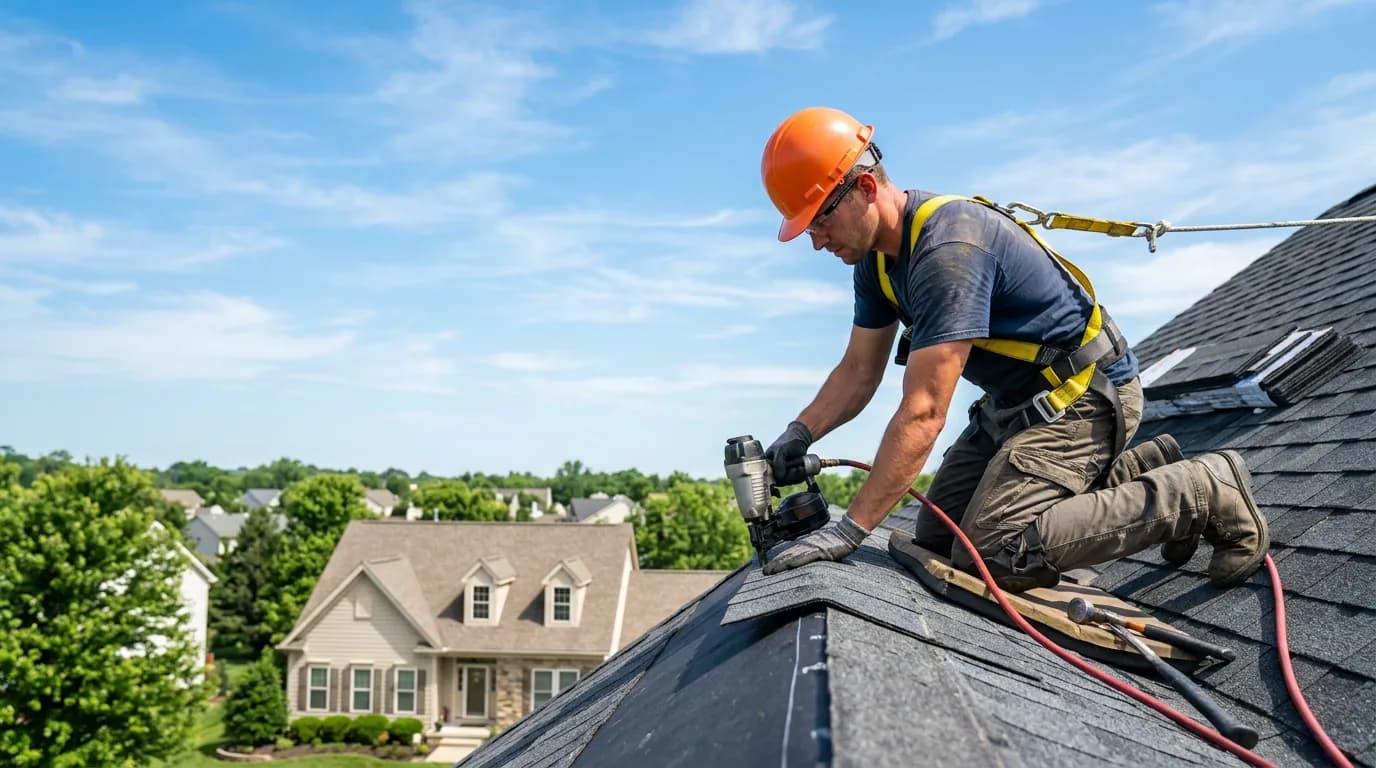
Roofer inspecting storm-damaged shingles on a house roof, in navy and amber tones

Online challenges for roofing companies

Owners hesitate before asking a roofer for a survey: they fear a hard sell, a surprise bill or a crew that never turns up.

A form or a button that answers none of that loses them.

After a storm, searches peak faster than most roofing pages can turn them into calls

When leaks start, people pick the first believable roofer who says clearly what emergency work they do.

  • General pages miss the words people add when it is urgent and lose calls to quicker competitors.
  • Emergency repairs and planned replacements should not share the same route to a call.

Heavy photo galleries slow the phone page just when people want to call

Photos of your work matter, but oversized images slow down visitors who arrive on a phone.

  • Slow loading and pages that jump around on a phone lose emergency calls.
  • Your project pages should help you be found and let people get in touch at once.

A form that asks for roof photos owners cannot take

Requests that demand photos of the roof stop owners who have no way of seeing it from the ground.

  • They leave the form half filled in, and the firm never learns they wanted a survey.
  • Those who climb up to take the picture are the ones a roofer least wants on a ladder.

Conversion Optimisation approach for roofing companies

For roofing companies, we aim the tests at faster paths for visitors in a hurry: a simpler way to call, a shorter form and proof on the first screen.

The doubts that stop an owner before the form

A visitor on a roofing page is usually afraid of three things: an open-ended bill, a firm that disappears and a job left half done in the rain.

  • Next to the button we answer them briefly: the survey is free or priced as stated, the quote is itemised, and the page shows who will stand on the roof.
  • Proof sits where the doubt arises, so the warranty wording and trade memberships appear beside the request form and not on a separate page few people open.

A phone button and a form that work one-handed

Many visitors arrive on a phone, some of them holding a bucket.

  • We watch recordings of real visits to see where thumbs miss: a number that cannot be tapped, a form that rejects the way a postcode was typed, a photo upload that fails on a slow connection.
  • The survey form is cut to what is needed for a first answer, and everything else is asked on the call.

Small site, careful conclusions

A roofer's site does not get enough visits for quick experiments with two versions side by side.

  • So we change one important thing at a time, leave it long enough to cover both dry and stormy spells, and compare calls and forms with the same period before.
  • Each change is judged by surveys booked and by whether the jobs fit, and a change that only brings more tiny repairs is taken back.

Conversion Optimisation process for roofing companies

01

Where visitors stop

We look at where visitors leave and read the questions people ask by phone and email before they decide.

02

Doubts answered

We answer the main doubt next to the button and shorten the form or the booking path. For roofers, we ask the office what customers want in writing before they agree to a survey, such as a written warranty on the work, and that goes beside the form.

03

One change at a time

We change one thing at a time, because a small site has too few visits for quick tests.

04

Judging the result

We judge a change by the enquiries that follow, and undo it if it brings more enquiries of the wrong kind.

Planning a roof replacement with the homeowner, with measuring tools and safety gear

How we measure results for roofing companies

We count survey requests and calls from each roof page and compare them across a whole season, because one stormy week distorts everything.

Questions about Conversion Optimisation for roofing companies

Plain answers about Conversion Optimisation, written for roofing companies.

With the pages that already receive visitors: the repair page, the replacement page and the contact page.

  • We look at them on a phone as an owner with a leak would, and then as someone planning a new roof.
  • The first fixes are nearly always the same kind: the number, the form and the proof next to them.

Making the next step obvious and small.

  • A visible phone number with the hours someone answers, a form with few fields and a photo upload, and real job photos near the button.
  • Saying which areas and which roofs you cover also helps, because a visitor who is unsure whether you come to their town tends to leave.

Yes, but with patience and modest claims.

  • With little traffic we do not pretend to prove small differences.
  • We make changes that are clearly sensible, record calls and forms before and after over comparable weather, and say honestly when a result could be chance.
  • Recordings of single visits often teach more than any percentage.

Then it is reversed.

  • More enquiries about work you do not want cost the office time and help nobody.
  • That is why every change is checked against what happened next: was a survey made, was a quote sent, did the job fit your crews.
  • The aim is a fuller diary of the right work, not a louder phone.

General questions about Conversion Optimisation, the same for every trade, are in our FAQ.

FAQ: Conversion Optimisation

Need a growth plan for roofing companies?

Share your goals and constraints. We will turn them into a practical Conversion Optimisation plan for roofing companies.