
Website Development for HVAC Companies

A website for an HVAC company has to make an emergency call and a maintenance plan sign-up equally easy, with a design that changes with the season.

We show financing, rebate deadlines and equipment in stock honestly, and the forms send home servicing requests and commercial maintenance quotes to different queues, so your team does not sort them by hand.

See the full Web Design and Development service·See what we offer HVAC companies

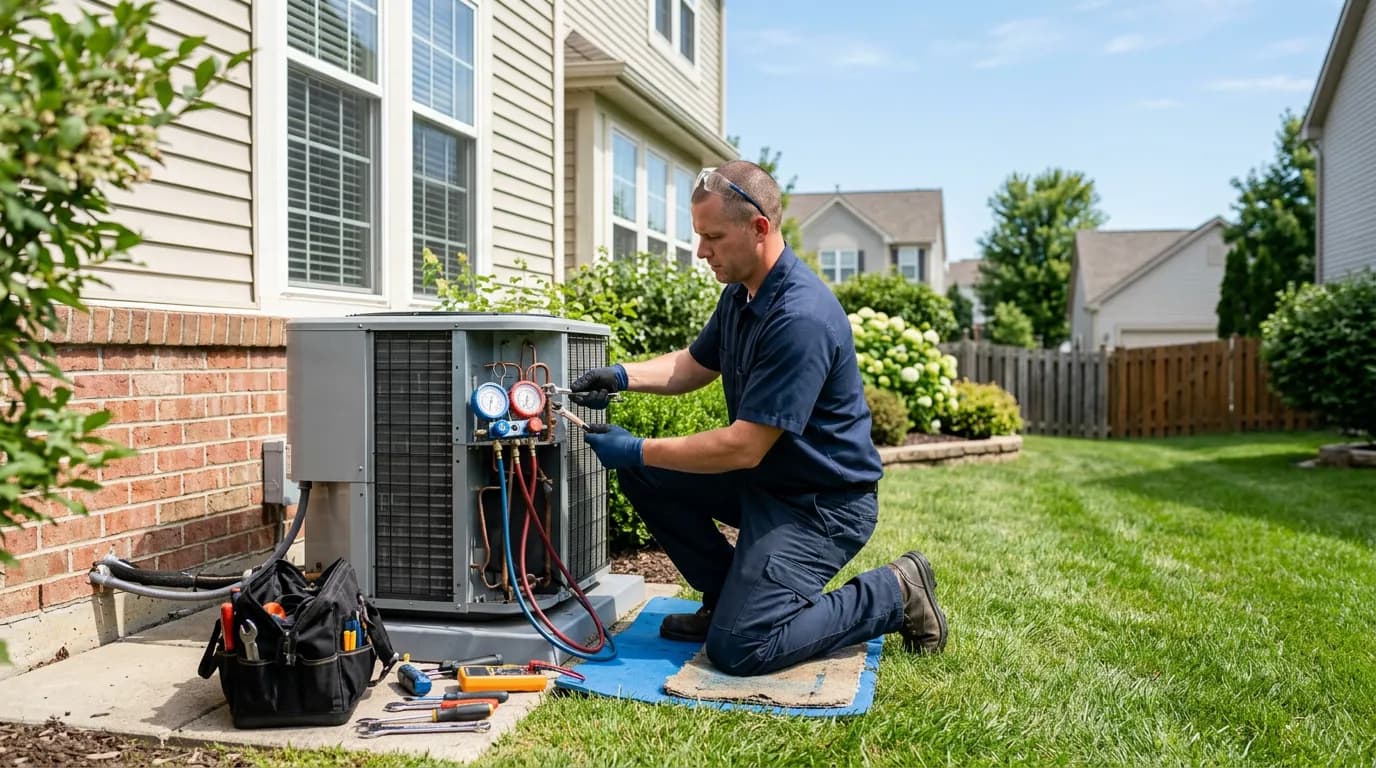
Heating and air conditioning technician adjusting the climate controls in a modern home, in soft navy and amber tones

Online challenges for HVAC companies

Many HVAC websites look like manufacturer mini-sites: heavy images, a slow first screen and maintenance plan details hidden deep inside.

Homeowners on a phone leave before they see the next free servicing slot.

We design for both: the visitor with a sudden breakdown and the one calmly comparing replacements.

Repairs and maintenance plans earn money in different ways

Emergency repairs and yearly maintenance plans are found through different searches and bring different margins.

  • When both share one page and one message, the calls that come in do not match the work your engineers should be doing.
  • And too little effort goes into the repeat income that evens out the year.

Manufacturer rules punish vague claims in ads and on key pages

Warranty and brand rules limit what you can promise, so your wording must stay precise.

  • Vague claims bring weak clicks, ads that Google rejects and pages that lose buyers who know the products.
  • Write within the brand rules from the start, not as an afterthought.

Install galleries that make the page crawl on a phone

Heating installers have good photos of their work and often put all of them at the top of the page.

  • On mobile data the phone number and the arrival time load after the pictures, which is the wrong order for a breakdown.
  • Heat pumps, boilers and split units squeezed onto one page leave each buyer hunting for their own equipment.

Web Design and Development approach for HVAC companies

For HVAC companies, the website plan starts from the proof people look for: manufacturer certifications, proof of energy efficiency and warranty terms.

We design the breakdown path and the servicing path separately first, then share the common parts.

We connect booking and financing tools only where they make booking shorter, never where they would get in the way of an emergency call.

Two first screens: breakdown and planning

Emergency pages put the phone number and the expected arrival time first.

  • Replacement pages put efficiency comparisons, grant deadlines and financing first.
  • The shared menu does not send a visitor with a breakdown to a page written for someone planning calmly.

Building blocks for each type of equipment

Heat pumps, boilers, split units and indoor air quality share one design, but each keeps its own questions, photo gallery and structured data, the code that describes a page to search engines.

  • The site is built faster, and your pages do not compete for the same searches.

A load-time limit for pages full of photos

We compress install photos, load galleries only when the visitor scrolls to them and start the chat window after the page has appeared.

  • Each page template has a load-time limit, so rich visuals do not slow down calls and bookings on a phone.
  • The call and booking buttons work at once, while heavier images load in the background.

Forms that fit your CRM

The form asks whether the job is for a home or a business, with an optional upload of energy bills for estimating the savings of a replacement.

  • Each answer lands in the matching field of your CRM, the system where you track enquiries, so home and commercial requests arrive in separate queues, not in one long email.
  • Clear fields make the handover to sales and installers smoother.

Web Design and Development process for HVAC companies

01

Mapping the paths

We walk through the breakdown, servicing and replacement paths on real phones and time each step.

02

Design and connections

Before building, we match the form fields to your CRM, where you track enquiries, and to the booking system you use.

03

Build and speed test

On a test version of the site we check the load-time limits (Core Web Vitals, Google's measures of page experience), call tracking and analytics.

04

Launch training

Your team learns to change seasonal banners, rebate badges and stock notes without breaking the layout.

Price: a website for HVAC companies with 1–3 pages starts at €650, and a company website with 5–7 pages at €1,300, plus VAT.

Home heating and cooling service with an airflow check and seasonal equipment in a stylish interior

How we measure results for HVAC companies

We measure started bookings, taps on the phone number and how far people get in the form, by traffic source.

After launch we check that the pages that rank in search and their structured data (code that describes a page to search engines) survived the move.

1.8s
faster first screen on every emergency page
34%
higher share of visitors starting to book a visit after we made the site easier to use
2.4×
faster from arriving on a heatwave page to making the call

Example figures from client projects with HVAC companies. Outcomes vary by market, offer and how consistently the plan is carried out.

Questions about Web Design and Development for HVAC companies

Plain answers about Web Design and Development, written for HVAC companies.

Yes.

  • We connect forms, booking and marketing automation to the platforms HVAC companies commonly use.
  • A service request then arrives with the unit type, the fault and the address, ready to be scheduled.

A redesign always carries some risk.

  • We keep it low with careful redirects, by keeping the important content and by watching the results closely after launch.

Pop-up windows and secondary buttons keep the emergency path clean, while financing stays easy to find on replacement pages.

  • Someone with a broken unit in a heatwave needs the phone number, not a payment plan.

Yes, if your market needs it.

  • We set up the language versions so that search engines show each visitor the right one.
  • In Cyprus, for example, many villa owners read English while local households may prefer Greek, prepared with a partner who works in Greek.

Fixing the phone version of an existing site takes a few weeks.

  • A new standard site takes 4–8 weeks, and sites for several locations take longer, depending on the integrations.

General questions about Web Design and Development, the same for every trade, are in our FAQ.

FAQ: Web Design and Development

Need a growth plan for HVAC companies?

Share your goals and constraints. We will turn them into a practical Web Design and Development plan for HVAC companies.