
LOCAL SERVICES · GOOGLE ADS
44 Calls in 30 Days: Google Ads Restructure Wins
A Greater Toronto Area local services brand consolidated a bloated Google Ads account into three intent tiers and more than doubled qualified calls in one month.
6 min read
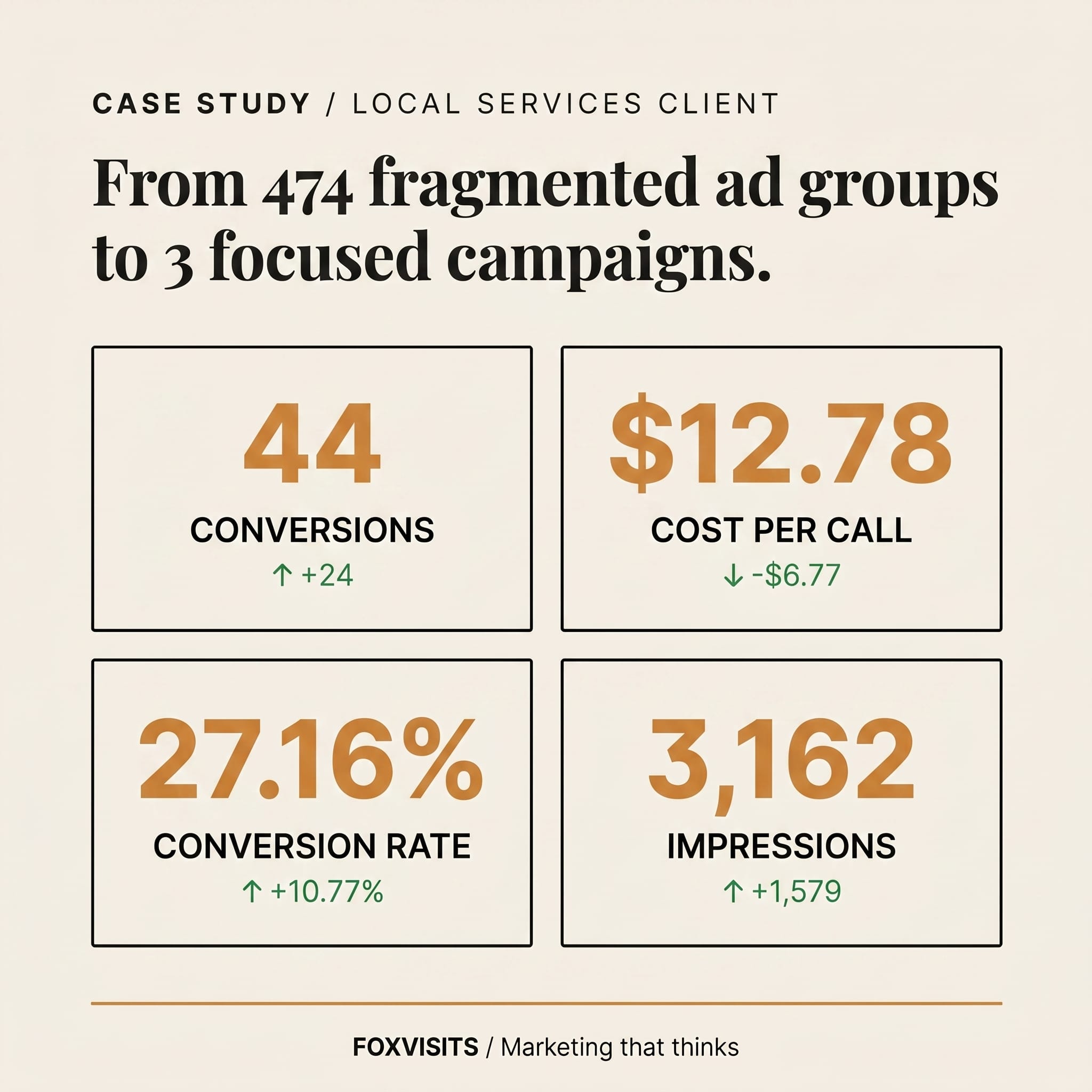
A Greater Toronto Area local services brand consolidated a bloated Google Ads account into three intent tiers and more than doubled qualified calls in one month.
The client came to us with a Google Ads account that looked busy on the surface but was leaking budget in every direction. 474 ad groups spread across multiple campaigns, with spend fragmented so thin that no single ad group had enough conversion data for Google's machine learning to optimize against. The account ran on autopilot with no clear hierarchy between high-intent and low-intent searches.
For a pay-per-call business in a competitive local services market, cost per call and conversion rate were too weak to scale. Every dollar wasted on impressions that did not convert was a dollar that should have been buying calls.
Project Overview
Primary Goal
More qualified calls at a lower cost per call
We replaced dozens of campaigns with three focused structures: emergency and immediate-need searches (highest intent, highest bids), scheduled and planned searches (medium intent), and branded plus defensive terms (high intent, controlled cost).
Inside each campaign, ad groups were consolidated by service type instead of keyword variation. Each group finally had enough conversion volume for Smart Bidding to learn from.
We rebuilt conversion tracking to count only qualified calls over 60 seconds as conversions, so the bidder optimized for real leads, not misclicks or hang-ups.
We cleaned negative keyword lists and applied a tight geo-fence aligned with the client's actual service area, cutting waste from out-of-area clicks.
The summary graphic in the hero shows headline KPIs after restructure. The table below is the only place with full before and after numbers for the same 30-day windows.
| Metric | Before | After |
|---|---|---|
| Conversions (30 days) | 20 | 44 |
| Cost per call | $19.55 | $12.78 |
| Conversion rate | 16.39% | 27.16% |
| Impressions | 1,583 | 3,162 |
| Total spend | $391.03 | $562.30 |
The lesson is not that fewer ad groups always win. Account structure should match how Google's bidding works in 2026, which means consolidating signal, not spreading it across hundreds of thin groups.
Many older Google Ads accounts were built when manual bidding and granular control were best practice. Smart Bidding now rewards accounts that give it enough conversion data to learn from.
If your Google Ads account has more than about 50 ad groups for a single-location local services business, there is almost certainly a restructure opportunity worth auditing.
We'll review campaign structure, conversion tracking, and search intent, then show where spend is leaking and what to fix first.