
Paid Social vs Google Ads: When to Use Which
Compare paid social and Google Ads by intent, funnel stage, and commercial outcome. Choose the right mix for your goals.
Quick answer
Google Ads (Search) captures existing high-intent demand: people already searching for a solution. Paid social creates demand and works best for awareness, consideration, and retargeting. If lead volume is the goal, start with search and add social for retargeting and lookalikes. Never split the budget evenly without defining each channel's specific job.
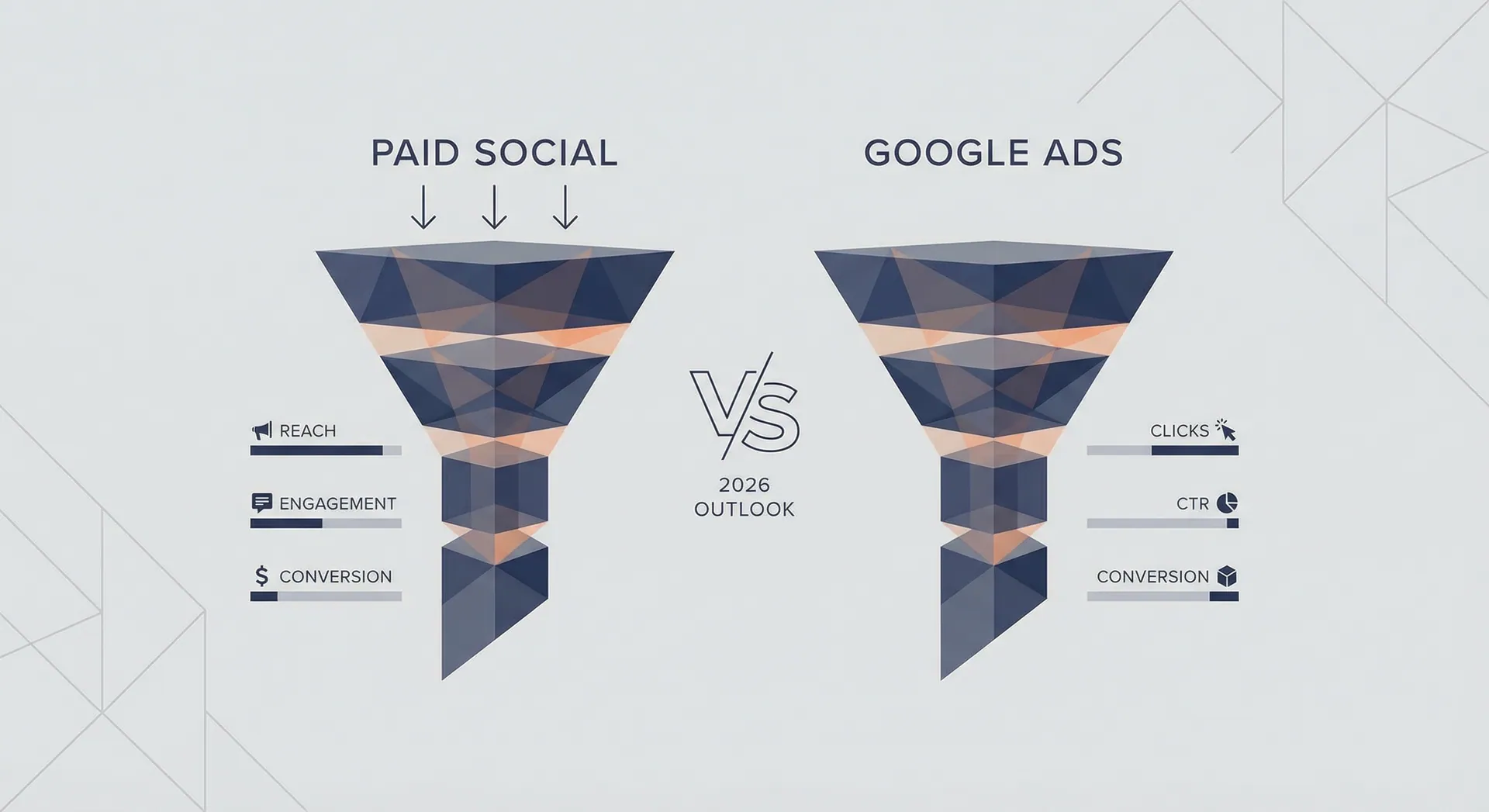
Paid social and Google Ads serve different parts of the funnel.
Choosing one over the other by default wastes budget; the right mix depends on intent, product, and commercial goals.
This guide helps you decide allocation and when to lean on each channel.
If your question is paid search against organic search, read Google Ads vs SEO instead.
Intent and Funnel Fit
Google Ads (Search) captures high-intent, active demand.
Users are searching for a solution; your ad meets that moment.
Paid social (Meta, LinkedIn, etc.) is largely demand creation: you interrupt with content and retarget.
Use search for bottom-funnel conversion and retargeting; use social for awareness, consideration, and lookalike expansion.
Channel Comparison
| Dimension | Google Ads (Search) | Paid Social |
|---|---|---|
| Intent | High (user-initiated) | Lower (ad-initiated) |
| Best for | Leads, sales, local actions | Awareness, consideration, retargeting |
| Attribution | Often last-click clear | Multi-touch, assisted |
| Creative need | Text and simple assets | Strong creative and iteration |
Budget Allocation Heuristics
Avoid splitting budget evenly without defining each channel’s job.
Role clarity improves measurement and optimisation.
- If lead quality and volume are the goal: start with search, then add social for retargeting and lookalikes.
- If brand and consideration matter: invest in social first, then search to capture branded and category demand.
- If both matter: run both with clear role definitions and shared attribution view.
Measurement and Governance
Use a single attribution view (or at least a consistent model) across both.
Report by channel role: search for conversion, social for assisted and reach.
Review mix quarterly; shift budget when one channel’s marginal return drops or the business goal shifts.
Paid social and Google Ads are complementary. Define each channel’s role, measure with one lens, and adjust the mix as goals and performance evolve.
Need a paid channel strategy that fits your funnel? We can design allocation and measurement.
Book a strategy consultationFrequently asked questions
Should we use both from day one?
Often start with one (usually search for direct response) and add the other when you have conversion volume and creative to test.
Which is better for B2B?
Both can work. Search for high-intent terms; LinkedIn for targeting and thought leadership. Match creative and offer to platform.
How do we attribute across channels?
Use one attribution model across both, in practice data-driven, since GA4 and Google Ads no longer offer linear or position-based models, and look at attribution paths so social gets credit where it assisted.
When should we reduce one channel?
When the cost of each extra customer or result rises above target, or when the channel’s role is no longer aligned with current goals.