Competitor SEO Analysis: From Insights to Action

How to run a competitor SEO analysis that identifies real opportunities across content gaps, authority signals, and conversion intent.

Radosław DownarFebruary 22, 20269 min read
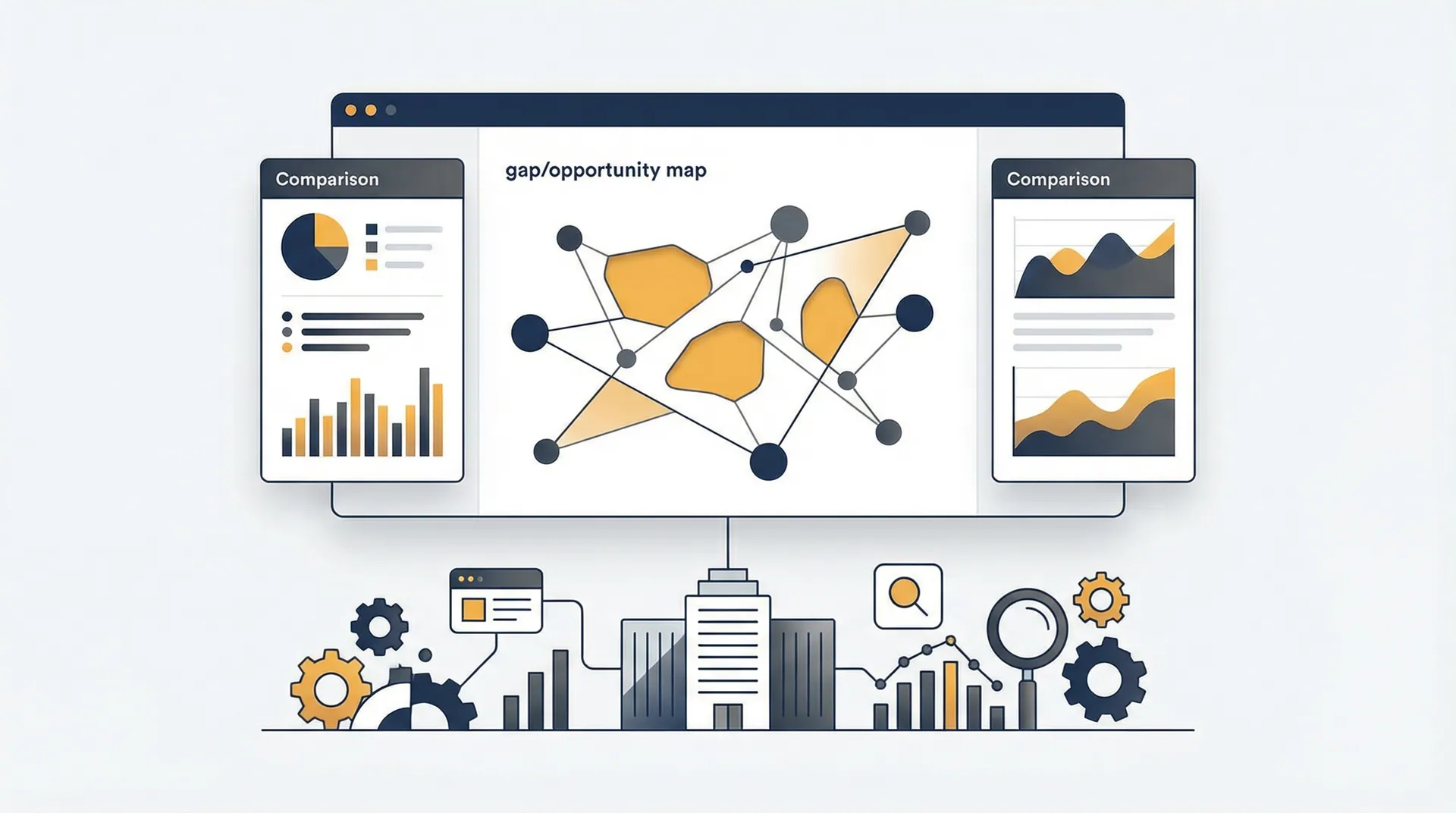
SEO competitor comparison dashboard with gap and opportunity map

Competitor SEO analysis is useful only when it leads to priority decisions. Copying competitor pages blindly creates noise, not advantage.

The goal is to identify where your competitors are strong, where they are vulnerable, and where your brand can win with distinct value.

Choose the Right Competitor Set

Separate business competitors from search competitors. In many categories they are not the same.

Build a core set of 3-5 search competitors per topic cluster.

Gap Types That Matter

  1. Coverage gaps: topics you do not address.
  2. Depth gaps: competitor pages answer intent better.
  3. Authority gaps: weaker external references and trust signals.
  4. Conversion gaps: poor CTA and commercial path on your pages.

SERP Intent Pattern Analysis

For each target query, inspect what formats Google rewards: guides, comparisons, tools, local pages, product pages. Matching intent format is often a bigger lever than word count.

Track SERP feature occupancy (FAQ, video, local pack, AI overviews where applicable).

Opportunity Prioritization

OpportunityEffortExpected Impact
High-intent page missingMediumHigh
Upgrade weak existing pageLow-MediumMedium-High
Authority support campaignMedium-HighMedium
Long-tail cluster expansionMediumMedium

Execution Rhythm

Convert analysis into a quarterly backlog with clear owners and deadlines. Re-run competitor benchmarks monthly on priority clusters.

From Competitor Benchmark to Execution Backlog

Competitor analysis is useful only when converted into action backlog with ownership. Every identified gap should map to one decision: create new asset, upgrade existing page, or reinforce authority signals.

The biggest mistake is structural imitation without business-model alignment. The objective is not similarity; it is superior decision support and conversion pathway quality.

Opportunity Scoring Model

Use a 1-5 scoring framework for business value, intent gap, implementation effort, and time-to-impact. This reduces subjective prioritization and aligns cross-functional decisions.

Refresh scoring monthly for top clusters because competitor movements often outpace internal quarterly planning cycles.

CriterionQuestionScore
Business valueWill this move pipeline quality or volume?1-5
Intent gapIs competitor intent coverage stronger?1-5
Execution feasibilityCan we ship in 1-2 sprints?1-5

Decision Model for Growth Teams

Most SEO initiatives fail because strategy and execution decisions are mixed without one evaluation model. Teams ship activity, but they do not rank initiatives by impact, speed-to-value, and operational cost.

A practical decision model fixes this: score each initiative by commercial impact, implementation effort, and governance complexity. If impact is low and maintenance cost is high, it should not enter the sprint backlog even if it looks attractive on paper.

  • Priority 1: highest impact on qualified demand and conversion quality.
  • Priority 2: initiatives that improve process reliability and data trust.
  • Priority 3: controlled experiments with explicit success criteria.

30/60/90-Day Execution Blueprint

Days 1-30 focus on diagnosis and baseline: data hygiene, intent mapping, KPI baselines, and bottleneck discovery. The objective is not volume of output; it is removal of friction that suppresses performance.

Days 31-60 prioritize highest-leverage deployment on templates and channels with strongest commercial impact. Days 61-90 institutionalize iteration, ownership, and reporting cadence so results are repeatable rather than campaign-dependent.

  1. Days 1-30: audit, baseline KPIs, decision priorities.
  2. Days 31-60: deploy highest-leverage changes.
  3. Days 61-90: iterate on data, codify governance, scale.

Baseline

Deployment

Iteration

Scale

KPI Governance and Accountability

Your KPI stack should connect visibility, behavior quality, and business outcomes in one causal chain. If reporting stops at top-of-funnel metrics, teams optimize activity rather than commercial impact.

Every KPI needs an owner, target range, and review cadence. Ownership is what turns dashboards into decision systems.

LayerOperational KPIBusiness KPI
Visibilitycoverage, CTR, index qualityshare of qualified demand
Traffic qualityengagement, assisted actionslead quality / SQL ratio
Commercial outcomeexecution cost and cycle timepipeline, revenue, payback

Risk Register and Mitigation

Common growth risks are channel-message mismatch, unresolved technical debt, and misaligned definitions between marketing and sales. These failures often erase gains from otherwise solid strategy.

Maintain a risk register with early signal, owner, intervention threshold, and mitigation action. This governance artifact reduces reaction time and protects compounding performance.

Sustained growth is a governance outcome: repeatable decisions outperform one-off tactical wins.

SEO-AIO-GEO Readiness Before Scaling

Before increasing volume, validate three layers: SEO (intent fit and technical integrity), AIO (answer-first structure and citation readiness), and GEO (entity consistency and local context where relevant).

Content should provide direct executive-grade answers, operational frameworks, and measurable KPIs. This raises utility for users and improves citation potential in AI-generated discovery surfaces.

  • SEO: intent alignment, information architecture, technical stability.
  • AIO: direct answers, procedural structure, entity clarity and evidence.
  • GEO: local context, entity consistency, trust and reputation signals.

Execution Ownership and Delivery Precision (1)

For "Competitor SEO Analysis: Practical Framework", implementation quality improves when ownership is defined at weekly action level, not only quarterly targets. Without operational ownership, strategy quality rarely translates into stable outcomes.

Use a simple format per initiative: owner, deadline, KPI, and acceptance condition. This reduces decision latency and protects execution consistency.

Process Quality Metrics (2)

Beyond outcome KPIs, track execution process quality: cycle time, number of iterations to acceptance, and performance stability after 30/60 days.

This helps distinguish temporary uplifts from durable improvements and sharpens next-cycle prioritization.

  • decision-to-deployment cycle time
  • first-cycle execution quality
  • post-release stability of outcomes

Operational Risk Controls (3)

Common execution risks include priority misalignment, data inconsistency, and publication delays. Each risk should have an owner and an explicit mitigation trigger.

A lightweight risk register with thresholds often improves decision quality faster than adding new tools.

Quarterly SEO-AIO-GEO Iteration Layer (4)

At the end of each quarter, refresh high-intent sections, update evidence blocks, and tighten decision-focused answers. This keeps content citation-ready and commercially useful.

Consistent iteration protects topical authority while improving predictability of pipeline impact over time.

Execution Ownership and Delivery Precision (5)

For "Competitor SEO Analysis: Practical Framework", implementation quality improves when ownership is defined at weekly action level, not only quarterly targets. Without operational ownership, strategy quality rarely translates into stable outcomes.

Use a simple format per initiative: owner, deadline, KPI, and acceptance condition. This reduces decision latency and protects execution consistency.

Process Quality Metrics (6)

Beyond outcome KPIs, track execution process quality: cycle time, number of iterations to acceptance, and performance stability after 30/60 days.

This helps distinguish temporary uplifts from durable improvements and sharpens next-cycle prioritization.

  • decision-to-deployment cycle time
  • first-cycle execution quality
  • post-release stability of outcomes

Operational Risk Controls (7)

Common execution risks include priority misalignment, data inconsistency, and publication delays. Each risk should have an owner and an explicit mitigation trigger.

A lightweight risk register with thresholds often improves decision quality faster than adding new tools.

Strong competitor analysis does not imitate. It sharpens strategy and execution priorities so your team wins where it matters commercially.

Need a competitor SEO map translated into a practical execution backlog? We can build it with priority scoring.

Book a strategy consultation

Frequently asked questions

  • How many competitors should we track?

    Usually 3-5 per core cluster is enough for decision quality without analysis overload.

  • Should we replicate competitor structure exactly?

    No. Match intent expectations, then differentiate with stronger evidence and clearer commercial pathways.

  • How often should we refresh competitor analysis?

    Monthly for priority topics and quarterly for broader strategic review.

  • What is the biggest mistake?

    Treating competitor analysis as a report artifact instead of an execution input.

Radosław Downar, Founder of FOXVISITS

Radosław Downar - Founder & CEO at FOXVISITS

Radosław has 18+ years of practical experience in SEO, paid media, and website strategy. He helps companies build accountable growth systems based on commercial outcomes, not vanity metrics.

Want to implement this for your business?