AI Search Visibility for Businesses in Cyprus: What You Can Influence and What Nobody Can Promise
How a business in Cyprus gets described correctly by ChatGPT and Google's AI answers, in Greek and English: what to align, what to test, what it costs.
Quick answer
An AI tool can only describe your business from what the web says about it, so in Cyprus the work starts with the same facts, in every language your customers use, on your website, your Google Business Profile, the company register and the register of your profession. Then ask the same buyer questions every month in Greek and English and record mentions, recommendations and citations separately; nobody can promise any of the three, or a date. Our AI & GEO work starts from €400 a month plus VAT for a basic scope, with a three-month minimum.
When someone in Limassol asks ChatGPT for an accountant who works with small companies, or a family asks Google which villas near Paphos stay open in winter, the answer may name a few businesses and show a few sources.
AI search visibility means your business is among them and the answer tells the truth about it.
Much more is known about where these systems look than about how they choose, and those sources are what a business can influence.
This guide covers what is particular to Cyprus: customers who ask in more than one language, registers that let anyone check a business, and the questions worth testing.
What GEO is in general is explained in What Is GEO?, and the step-by-step work for any business in how to appear in ChatGPT answers.
Where does an AI answer about your business come from?
From the pages the tool can find when it answers or, for a chat model that does not search, from what it learned in training.
Editing your website can change the first, not the second.
Google lists Cyprus among the places where AI Overviews and AI Mode are available, with Greek and English among their languages.
A page can appear in them if it is in Google's index and allowed to show the short description under its link, the snippet.
Google says no special files, markup or schema are needed, and its advice to site owners includes keeping Business Profile information up to date.
OpenAI says sites that block OAI-SearchBot, the robot that collects pages for ChatGPT search, are not shown in its search answers.
Perplexity says its own robot surfaces and links websites in its results, and that it may visit a page to answer a question.
How these systems pick between the pages they find is not published.
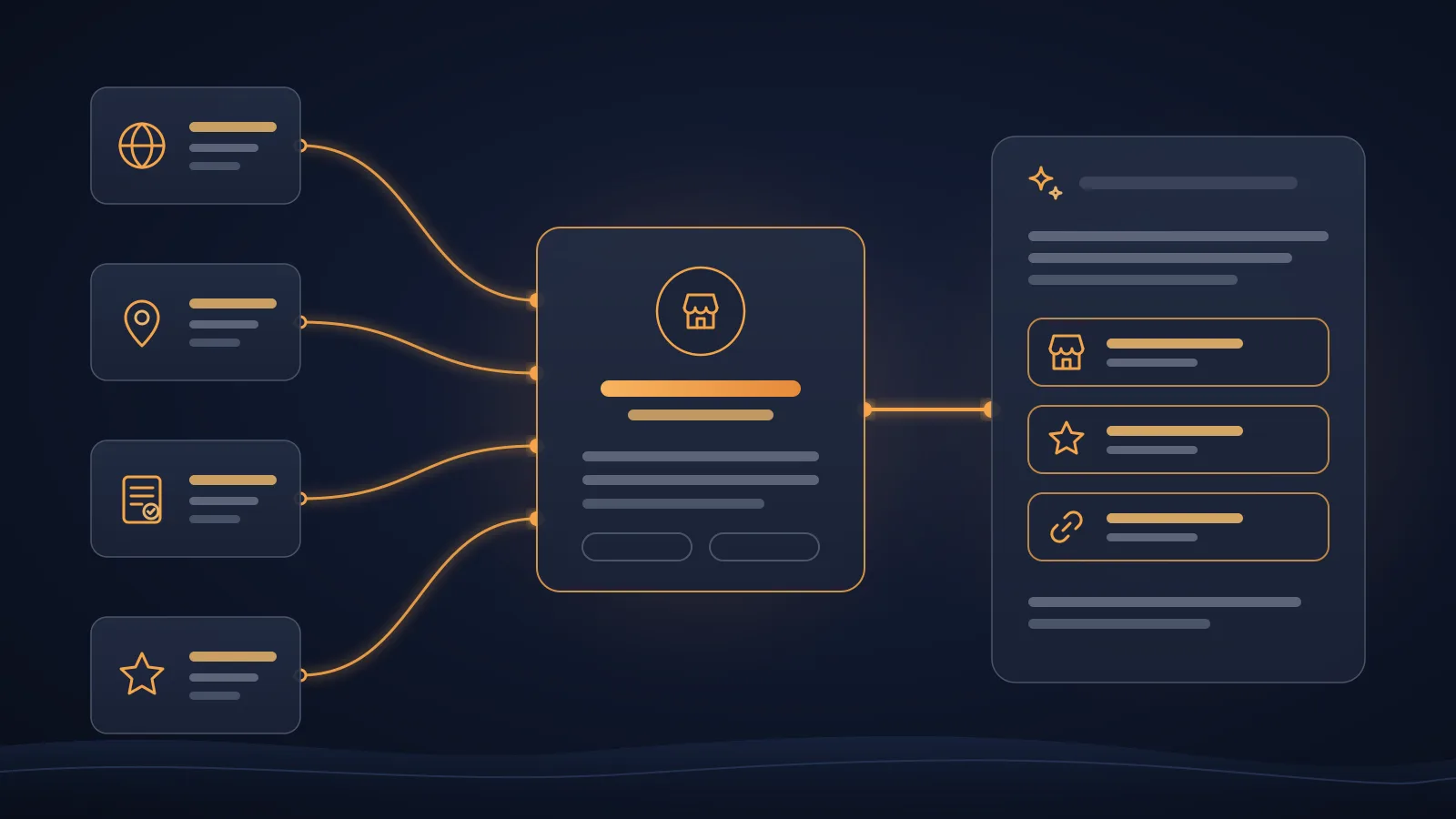
What you can work on is the facts about your business wherever they appear, pages that answer your customers' questions, and independent sources that confirm both.
Which places describe your business in Cyprus, and what should each one say?
List every place that describes you, from the ones you control to the ones where you can only ask for a correction.
In Cyprus that includes public registers where anyone can check a business.
Anyone can search the company register online, and the basic details are free.
If you trade under another name, show the legal name and registration number on your website too, so anyone can see that the two names belong together.
Some professions have their own registers: the Cyprus Bar Association publishes its list of lawyers by district, and estate agents need registration and a licence from the Council of Real Estate Agents.
For most businesses on the island the list looks like this:
| Place | What it says about you | What to check |
|---|---|---|
| Your website | What you do, where, for whom, in which languages and at what price | Details that match your profile and the register, with the legal name and number |
| Google Business Profile | Name, category, address, hours, photos and reviews | Same name and phone, hours for the season and holidays, a link to the right page |
| Company register | Legal name, number, registered office and directors | The name and number on your site match it exactly |
| Register of your profession | For example the list of lawyers or the register of estate agents | Listed under the name you use; your site names the body and licence number |
| Tourism, booking and review sites | Booking platforms, review sites, visitcyprus.com | The same details, photos and season dates, and replies to recent reviews |
| Press, chambers and partners | Independent descriptions of what you do | Current services and people; if not, ask for a correction |
Do AI answers about Cyprus differ between Greek and English?
They can, so check both.
The same question asked in Greek and in English may bring different businesses, different sources or different facts.
Why they differ is not published, so test it rather than guess.
Ask in every language your customers use: Russian too for a Limassol firm with Russian-speaking clients, the languages guests write their enquiries in for a holiday rental near Paphos.
To begin, the 5–10 questions that bring the most work are enough, asked in each of those languages.
If the answers in one language are wrong or name nobody, check what exists in that language.
Sometimes nothing says what you do.
A page written for those customers is the honest fix, and it helps the people who read it whether or not an AI tool ever quotes it.
Town and street names, written several ways in Greek and Latin letters, are covered in our guide to local SEO in Cyprus.
We prepare Greek pages with a partner who works in Greek; whether you need a Greek version at all is answered in our guide to a multilingual website in Cyprus.
Which questions should a business in Cyprus test, and how?
The ones customers ask just before they choose someone, in their own words, taken from emails, calls and WhatsApp messages.
As illustrations: an English-speaking lawyer in Nicosia for a property purchase; an accountant for a small company in Limassol, and what it costs; a villa near Paphos with a heated pool that is open in January; car hire with a desk at Larnaca airport; a dentist in Limassol who speaks Russian.
Run the test the same way every month, or the months cannot be compared.
Our article on measuring GEO turns the records into a scorecard.
- Start with 5–10 questions in each language and grow the whole set to 20–30 over time. Keep the wording of every question fixed.
- Ask each one in the tools your customers use: ChatGPT with search, Google's AI Mode and AI Overviews, and Perplexity. Ask from Cyprus, in each of your customers' languages, and note whether you were signed in.
- For every answer, record four things: are you mentioned, are you recommended, is one of your pages cited as a source, and are the facts about you right. Note who is named instead.
- Save the answers with the date, repeat on the same day each month and compare with your own first round, not with anyone's average. The same question can get a different answer from one run to the next, so a change seen once is not yet a trend.
What should you fix when an AI answer gets your business wrong?
The source of the mistake, not the answer.
Open the sources the answer shows.
A wrong opening time or an old address usually comes from some page: an old directory entry, a forgotten page of your own site, a partner's page from years ago.
Correct what you control first, your website and Google Business Profile, then ask the owners of the other pages to update theirs.
Google's AI Overviews also let you report a problem through the thumbs-down icon.
The report goes to Google; it does not correct the page the mistake came from.
Then wait for your next monthly round.
No provider publishes when a corrected page is picked up.
Which AI visibility offers should you be wary of?
Any offer that sells what nobody outside the AI companies controls:
- A guaranteed place in ChatGPT or in Google's AI answers, or a date for your first citation.
- A list of "AI ranking factors". No provider publishes one.
- Special files or markup sold as the key to AI answers. Google says its AI features need none.
- Hundreds of AI-written pages for every town and question. Google's spam policies name this as an example of scaled content abuse: many pages produced with generative AI tools that add nothing for users.
- Reviews you did not earn, and paid mentions dressed up as independent ones. Both can be found out, and both undo the trust this work is meant to build.
What does AI & GEO work cost in Cyprus, and when will you see a change?
Our AI & GEO work starts from €400 a month plus VAT for a basic scope.
A wider scope, with more pages, more languages or more outside sources to put in order, is quoted after the free audit.
Monthly services have a three-month minimum, then 30 days' notice.
Every month you get the same test questions and a report that counts mentions, recommendations and citations separately.
Fixes to your pages and listings can be checked as soon as they are live.
No provider publishes when AI tools change their answers, so we give no date for that.
The parts of the work that are ordinary SEO follow the SEO timeline: first signals after 8–12 weeks, a clear effect after 4–8 months.
What differs by city is on our AI & GEO pages for Nicosia, Limassol, Paphos and Larnaca, and how we work across the island on our Cyprus page.
How will you know the work is paying off?
By four things, checked every month.
If the facts about you are right everywhere and none of them moves after several months, put the budget where your enquiries come from.
That is a fair result of an honest test.
- Your test: more mentions, recommendations or citations than in the first round, each counted on its own, and correct facts in every language.
- Referrals from AI tools in your analytics, such as chatgpt.com or perplexity.ai. Not every such visit arrives labelled, so read the count as a minimum.
- Search Console: Google counts its AI features in the Performance report, under the Web search type, together with ordinary results.
- Enquiries: when you ask new customers how they found you, add "an AI assistant" to the options.
An AI tool can only repeat what the web says about you, so make sure it says the same true things in every place and language. Our free audit shows what selected AI tools say about your business today and which gaps to close first.
Send us your website address and a few questions your customers ask. The free audit shows where selected AI tools mention, recommend or cite you today, and who they name instead.
Get a free AI visibility auditFrequently asked questions
Does my Google Business Profile matter for AI answers?
For Google's AI Overviews and AI Mode, keeping it up to date is on Google's own list of good practice for site owners. How much other AI tools use it is not published. Keep it accurate anyway, for Google Maps and ordinary search.
What if an AI tool confuses us with a business that has a similar name?
Make what sets you apart easy to find: your legal name and registration number on the website, the same address and phone number everywhere, and your town in the description of the business. Then correct the listings that mix the two businesses up, and report the answer where the tool allows it.
Can I check what AI tools say about my business myself?
Yes, with the monthly test described above. To begin, 5–10 questions in each of your customers' languages are enough. It needs no budget, only a fixed slot in your diary.
What should we prepare for a free AI visibility audit?
Your website address, the names you trade under and the company's legal name, links to the profiles you manage, and the questions customers ask you most often, in the languages they ask them.